
India has entered a new era of digital governance. With the Digital Personal Data Protection Act, 2023 (DPDP Act) and the subsequently notified DPDP Rules, 2025, organisations now have a clear, codified, and enforceable data protection regime—backed by timelines, duties, rights, and regulatory oversight.
Next batch: 21–22 October 2026
Get DPDP certified in 2 days
Accredited DPDP Act 2023 & Rules 2025 course for DPOs and privacy teams. ₹16,500 + GST.
View course & dates WhatsApp usThis article provides a comprehensive and implementation-focused view of the Act and Rules, along with a corrected compliance window, and a downloadable 1-page infographic summarising the framework.
1. Scope of the DPDP Act (Section 3)
The DPDP Act applies to:
- All digital personal data processed within India.
- Processing outside India if goods or services are offered to individuals in India.
- State entities, private organisations, individuals, companies, and firms.
- Both digital-native data and digitised offline data.
The Central Government has notified an 18-month compliance window to assist organisations in phased implementation.
2. Key Actors Under the DPDP Framework (Act Section 2; Rules 4, 17–23)
Data Principal: The individual to whom the personal data relates.
Data Fiduciary (DF): The entity that determines the purpose and means of processing.
Significant Data Fiduciary (SDF): Organisations that meet certain risk-based thresholds and are designated by the Central Government.
Data Processor: Processes personal data on behalf of a DF under a lawful contract.
Consent Manager (Rule 4)
- Must be an Indian company.
- Must maintain a registered platform with the Data Protection Board (DPB).
- Shall retain consent-related records for 7 years.
- DPB may suspend or revoke registration for non-compliance.
Data Protection Board of India (DPB)
- A digital-by-design adjudicatory body.
- Handles complaints, imposes penalties, orders remedial actions, and allows voluntary undertakings.
- Appeals lie with the Telecom Disputes Settlement and Appellate Tribunal (TDSAT).
3. What Counts as Personal Data? (Section 2(13))
- Any data that identifies or can identify an individual.
- The Act does not create a separate category for “sensitive personal data.”
- The Rules introduce additional safeguards for:
- Children (parental consent; no profiling, tracking, targeted advertising).
- Persons with disability under lawful guardianship (Rule 11).
4. Lawful Processing of Personal Data
A. Consent Requirements (Act Section 6; Rule 3)
Consent must be:
- Free, specific, informed, unconditional, and unambiguous.
- Based on a standalone notice with details mandated under Rule 3.
- Provided in English or any Eighth Schedule language.
The notice must include:
- Purposes of processing
- Data categories
- Goods/services enabled
- Withdrawal mechanism
- Grievance redress details
- Cross-border reference (if applicable)
- Retention principles
B. Legitimate Uses (No Consent Required) (Section 7)
A Data Fiduciary may process personal data without consent for:
- Voluntary data provided by the individual
- State functions (as per Rule 5 and Schedule II)
- Compliance with law or court orders
- Public health and disaster response
- Employment-related purposes
- Public order
5. Duties of Data Fiduciaries (Act Section 8; Rules 3–12, 14)
Security Safeguards (Rule 6)
DFs shall implement reasonable technical and organisational measures. This includes:
- Access control
- Encryption and masking
- Monitoring and logging
- Backups and disaster recovery
- Authentication controls
- 1-year mandatory log retention
Processor Management
DFs must ensure processors follow all security safeguards.
Retention & Erasure (Rule 8)
- Data shall be erased once the purpose is fulfilled.
- 48-hour prior intimation to individuals (where Rule 8 applies).
- Sectoral retention:
- Up to 3 years (e-commerce, social media, gaming).
- 1-year retention for State security cases.
Breach Notification (Rule 7)
DF must notify:
- DPB without delay
- Data Principals as soon as possible
- Submit full details within 72 hours
Children’s Data (Rules 10 & 12)
- Verifiable parental consent
- No tracking/profiling/targeted ads
- Limited exemptions for healthcare, education, real-time safety
Persons with Disability (Rule 11)
- Verifiable lawful guardian consent
Grievance Redress (Rule 9 & 14)
- Publish grievance mechanism
- Respond within 90 days
- Publish DPO or designated contact
6. Duties of Significant Data Fiduciaries (Act Section 10; Rule 13)
SDFs must:
- Appoint a Data Protection Officer located in India
- Appoint an independent data auditor
- Conduct an annual DPIA
- Conduct an annual independent audit
- Implement additional organisational and technical safeguards
- Ensure Government-identified restricted data does not leave India
7. Rights of Data Principals (Act Sections 11–14; Rule 14)
- Right to access personal data
- Right to correction and updating
- Right to erasure
- Right to grievance redress
- Right to nominate a representative
DFs must publish rights, verification steps, and timelines.
8. Cross-Border Transfers (Act Section 16; Rule 15)
- Data may be transferred unless restricted by the Central Government.
- Additional safeguards may be prescribed.
9. Research, Archiving & Statistics (Rule 16; Schedule II)
- Exemptions apply if strict standards are met.
- No decisions may be made about individuals using such processed data.
10. Data Protection Board & Penalties (Act Chapter V; Rules 17–23)
- Fully digital functioning
- Online complaints and hearings
- Mediation & voluntary undertakings
- Penalties up to ₹250 crore per violation
- Appeals to TDSAT
11. DPDP Compliance Timeline (Three Phases)
Phase 1 — Immediate (13 November 2025)
- Applicability & definitions
- Data Principal rights
- DPB establishment, penalties, appeals
Phase 2 — One Year Post-Publication (13 November 2026)
- Legal proceedings basis (Section 6(9))
- Cross-border safeguard for legal obligations (Section 27(1)(d))
- Consent Manager obligations commence (Rule 4)
Phase 3 — Eighteen Months Post-Publication (13 May 2027)
Operational implementation across:
- DF controls: security, breach response, retention, processors, children’s data
- Lawful processing: consent flows, legitimate uses, cross-border checks
- SDF duties: annual DPIA & audit, enhanced safeguards
- Enforcement-ready documentation
Note:
Government has notified an 18-month rollout. The Act/Rules do not define sub-phases beyond these effective dates.
12. SARAL Framework (PIB 3 January 2025 — Government Communication)
The Government describes the DPDP framework as SARAL:
Simple, Accessible, Rational, Actionable Law.
This is not a legal obligation but an interpretive design principle.
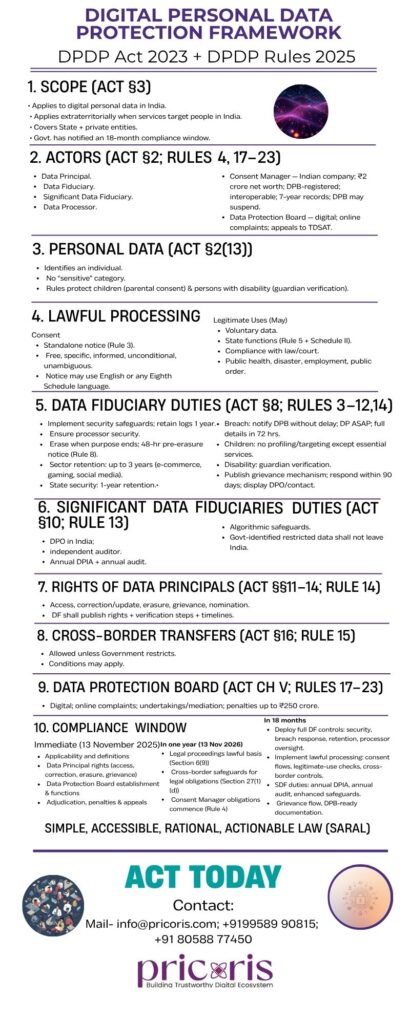
How Pricoris LLP Can Help
At Pricoris LLP, we support organisations in:
DPDPA Compliance Consulting- DPDP Act Training and Certification
- DPDP Act readiness assessments
- Data flow mapping and governance framework design
- Consent management architecture
- DPIAs and SDF classification
- Policy drafting and documentation
- Technical and organisational control implementation
- Incident and breach management readiness
- Board and workforce training
For assistance, contact:
📧 info@pricoris.com
📞 +91 95989 90815 | +91 80588 77450
Next batch: 21–22 October 2026
Get DPDP certified in 2 days
Accredited DPDP Act 2023 & Rules 2025 course for DPOs and privacy teams. ₹16,500 + GST.
View course & dates WhatsApp us