
Home » DPDP Act 2023 & DPDP Rules 2025 — A Practical, Human-Friendly Guide for Organisations
DPDP Act 2023 & DPDP Rules 2025 - A Practical Guide for Organizations
Introduction to DPDP Act 2023 & DPDP Rules 2025
India’s privacy law is finally complete.
The Digital Personal Data Protection Act, 2023 and the DPDP Rules, 2025 together create a modern privacy framework that every organisation working with personal data must now put into practice.
The shift is simple, but significant:
- You must explain clearly what data you collect and why.
- You must erase personal data once the purpose ends.
- You must enable people to access, correct and erase their data.
- You must notify individuals and the Board quickly when things go wrong.
This guide breaks the Act and Rules down into practical terms—without legal jargon—so teams can understand what is changing and what needs to be implemented.
It reflects the latest text from the Act and the Rules (7 Schedules) exactly as notified.
Why the DPDP Act Matters
India is now one of the world’s largest digital markets. With millions of users generating data through apps, payments, health records, travel, and customer interactions, the earlier “trust-based” model simply wasn’t enough.
DPDPA In 8 Buckets
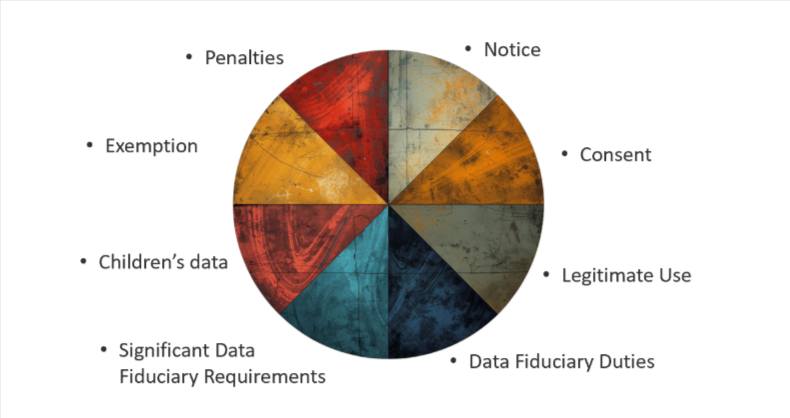
The DPDP Act introduces:
- Clear rights for individuals
- Clear duties for organisations
- A dedicated Data Protection Board (DPB) for enforcement
- Structured timelines for compliance
- A rules engine for practical implementation
Most importantly, the law adopts a modern, predictable approach—one that expects organisations to be transparent, respectful, and responsible in how they handle personal data.
Want Your Teams to Become DPDP-Ready?
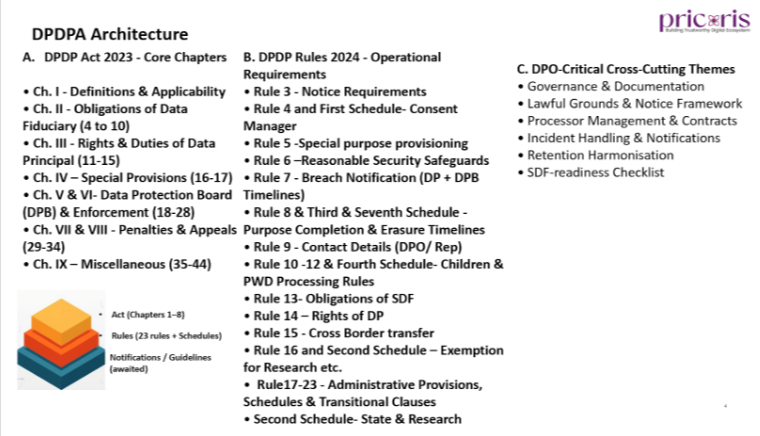
The Architecture of India’s Privacy Framework
(Act + Rules + 7 Schedules)
A) The Act
Defines the principles: rights, duties, legal grounds, penalties, exemptions, Board processes.
B) The Rules (23 Rules) and Seven Schedules
Operational elements: notices, consent, breach timelines, retention, children, SDFs, cross-border, log-retention.
- Schedule I — Consent Manager
- Schedule II — processing of personal data by State and its instrumentalities and research & development
- Schedule III — Notified category – ecommerce, online gaming and social media intermediary – retention and pre deletion notice
- Schedule IV — Exceptions for children and persons with disability (PWD) (e.g., real-time safety use cases)
- Schedule V — Terms and conditions of service of Chairperson and other Members
- Schedule VI — Terms and conditions of appointment and service of officers and employees of Board
- Schedule VII — Processing by state and its instrumentalities
Together, these components form India’s complete privacy regime.
Applicability- Who must comply
- Any personal data processed digitally in India
- Personal data that starts offline but becomes digital
- Processing outside India if tied to offering goods/services to people in India
- Personal data used for purely personal or domestic purposes
- Offline-only data never digitised
- Data that is self-published by the individual or legally required to be published
Core Definitions — Get the Roles Right
These four terms determine obligations:
Data Principal
The individual to whom the data belongs (includes parents of children + lawful guardians of persons with disabilities).
Data Fiduciary (DF)
The organisation that decides why and how personal data is processed.
Data Processor (DP)
A service provider processing personal data on behalf of the DF.
Significant Data Fiduciary (SDF)
Large or high-impact organisations designated by Government based on:
- volume
- sensitivity
- AI/ML usage
- national interest
- risk of harm
SDFs have stricter duties (DPO, audits, DPIA, algorithmic due-diligence).
Need Hands-On Help Implementing the DPDP Act?
- Pricoris provides end-to-end DPDP compliance consulting:
- Notice + consent redesign
- Retention & erasure workflows
- DSAR handling
- Legitimate Use register
- Security safeguards
- Processor contracts
- Breach governance
- PIMS (ISO 27701:2025) upgrade
- GDPR → DPDP alignment
Legal Grounds for Processing
(Consent + Legitimate Use)
Consent
Must be:
- free
- specific
- informed
- unambiguous
- unconditional
- based on clear affirmative action
Bundled or vague consent is invalid.
Legitimate Uses
The Act lists specific legitimate-use grounds, including:
- voluntary data provided for a particular purpose
- compliance with law
- emergencies
- employment-related purposes
- fraud prevention
- judicial orders
DPDP does not recognise GDPR-style “Legitimate Interest”.
It uses a strict, closed-list Legitimate Use category instead.
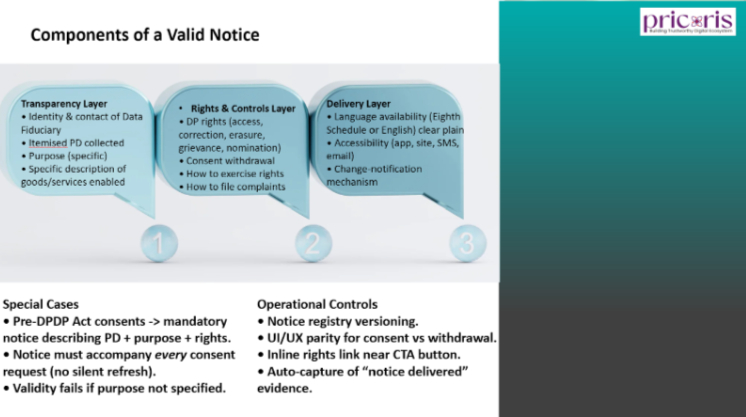
Notices — The Foundation of Lawful Processing
Notices (Rule 3 + Schedule Requirements)
A valid privacy notice must clearly explain:
- Identity / contact details of the Data Fiduciary
- What personal data is collected (itemised list)
- Purpose of processing
- Rights of the Data Principal
- Grievance officer details
- Language (English or any Eighth Schedule language)
- Change notifications
- Mechanism to withdraw consent
UI/UX matters.
Notice must be simple, accessible, and easy to understand.
Download Free DPDP Templates & SOPs
- Our DPDP Toolkit includes ready-to-use:
- DSAR Register
- Breach Register
- Notice Template
- Consent SOP
- Legitimate Use SOP
- Children’s Data SOP
- Data Protection Agreement
- Exemption cheat sheet
- Perfect for teams starting DPDP implementation.
Consent Managers — Optional for Data Fiduciaries
Consent Managers form a separate category of registered entities, with obligations under the First Schedule.
Data Fiduciaries may choose to use a Consent Manager but are not mandated to do so.
Consent Managers must:
- provide dashboards
- maintain logs for 7 years
- support APIs
- offer secure, tamper-proof consent records
- meet Indian incorporation + governance + financial criteria
Only Consent Managers must register under Rule 4.
Duties of Data Fiduciaries (DFs)
Data Fiduciaries must:
- maintain reasonable security safeguards
- ensure accuracy (when relevant)
- publish contact details
- allow withdrawal of consent
- provide grievance redressal
- implement retention + erasure as per Act & Rules
- manage processors through contracts
- notify breaches
- build internal governance for rights, notices, retention
These duties form the backbone of compliance.
Retention & Erasure — Where Most Organizations Struggle
Default Rule (Act + Rule 6)
Erase data when:
- purpose is complete
- consent is withdrawn
- retention period ends
Logs: minimum 1 year.
Third Schedule — Three-year inactivity rule
Applies to sectors like:
- large e-commerce
- OTT / gaming
- social media platforms
They must:
- delete data after 3 years of inactivity
- provide 48-hour pre-erasure notice
Seventh Schedule — One-year mandatory retention
Applies to specific sovereign/statutory categories only.
These details must flow into every organisation’s retention policy.
Breach Notification — India’s Strongest Obligation
Breach Notification Duties
Data Fiduciaries must notify:
- Data Principals — immediately
- Data Protection Board — immediately, followed by a detailed report within 72 hours
Large platforms must maintain logs for 3 years (Schedule VI).
Children & Persons With Disabilities (PWD)
(Section 10 + Schedule IV)
Strictest provisions:
- verifiable parental consent
- no tracking, profiling, targeted ads
- processing must not harm well-being
- exceptions exist for real-time safety functions
- guardian verification for PWD as per RPwD Act / National Trust Act
Significant Data Fiduciaries (SDF)
SDFs must implement:
- Data Protection Officer (reporting to Board)
- independent annual privacy audits
- DPIA
- enhanced algorithmic accountability
- localisation if notified
DPDP Readiness Scorecard (Free Tool)
Rights of Individuals
Every Data Principal has rights to:
- access
- correction
- completion
- updating
- erasure
- grievance redressal
- nomination (post-death)
DFs must respond within 90 days.
Cross-Border Data Transfers
(Schedule V)
DPDP follows a blacklist model:
- Transfers are allowed unless a country is specifically restricted.
- Financial, health and telecom sectoral localisation rules remain unchanged.
Exemptions
Limited exemptions exist for:
- sovereignty & security
- public order
- courts
- preventive/detection functions
- research & statistical uses
- startups (if notified)
Even with exemptions, Second Schedule principles still apply.
Penalties
Penalties & Appeals
- Up to ₹250 crore for security failures.
- DPB will follow digital-first proceedings.
- Appeals go to TDSAT.
Compliance Timelines
Immediate — 13 November 2025
- DPB setup
- Complaints and inquiries can begin
- Organisations must show “good-faith readiness”
12–13 Months — By 13 November 2026
- Consent Manager ecosystem becomes active
- Registration + dashboards + APIs + log-retention
18 Months — By 13 May 2027
Full DF compliance kicks in:
- notices
- consent
- legitimate use
- rights + 90-day SLA
- breach notification
- retention + erasure
- children/PWD rules
- cross-border allocation
- SDF duties
Early Readiness Advisory
IT Minister Ashwini Vaishnaw has confirmed that timelines may be shortened and urged companies to adapt GDPR/PIMS frameworks now, not later.
Download the DPDP 2025 Whitepaper
- A concise, senior-leadership-ready whitepaper analysing:
- Act + Rules + 7 Schedules
- Practical obligations
- Sectoral impact
- SDF requirements
- Retention logic
- Governance & audit expectations