
Ask most compliance teams if they’re ready for a DPDP audit and you’ll get a confident “yes.” Ask them to actually produce the consent logs, and the confidence drops fast.
Next batch: 21–22 October 2026
Get DPDP certified in 2 days
Accredited DPDP Act 2023 & Rules 2025 course for DPOs and privacy teams. ₹16,500 + GST.
View course & dates WhatsApp usThat’s the real story of DPDP audits right now. Everyone understands the law. Fewer people can prove they’re following it. And under the Digital Personal Data Protection Act, 2023, proof is the whole game. A policy document sitting in a shared drive doesn’t count for much if nobody can show it’s actually being used.
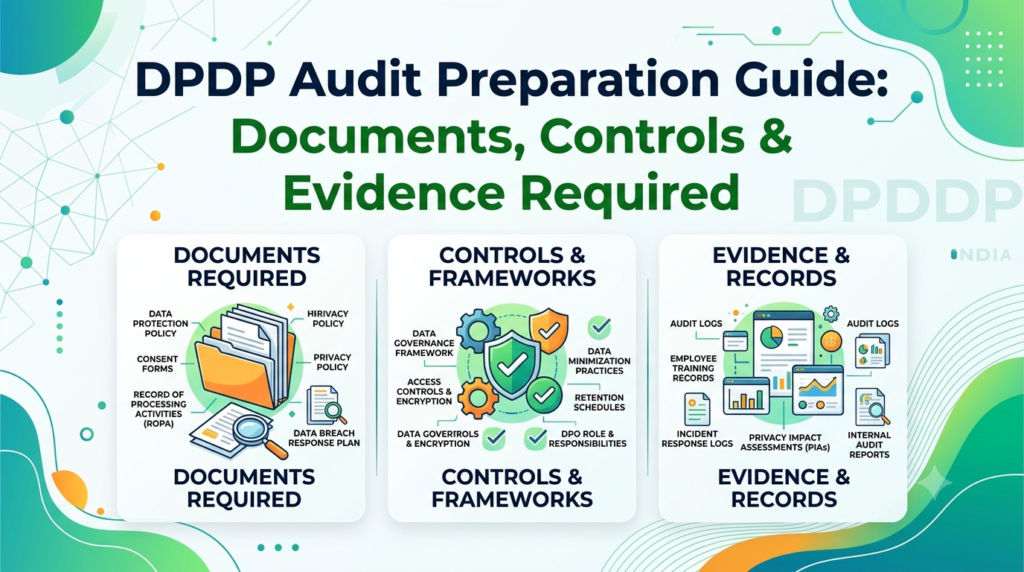
This guide covers what you’ll actually need: the documents auditors ask for, the controls that need to be working (not just written), how to catch your own gaps before someone else does, and where most companies stumble the first time.
What “Audit-Ready” Actually Means
It’s not about having a thick binder of policies. It’s about four things:
• Documentation that’s current, not something last touched when the Act was passed
• Controls that are running day to day, not sitting in a slide deck
• The ability to trace personal data from the moment it enters your systems to the moment it’s deleted
• A paper trail behind every compliance decision you’ve made
None of that lives in one department. Legal writes the policy. IT builds the control. The business team is usually the one actually collecting the data. If those groups aren’t talking, the gaps show up fast — usually during the audit itself, which is the worst possible time to find them.
The Documents You’ll Be Asked For
Data processing records. What you collect, why, where it comes from, who it’s shared with. Basic, but most companies don’t have this written down anywhere real.
Consent records. Not just “did they agree” — when, what they were told, and how they can withdraw. DPDP requires consent to be free, informed, specific, and unambiguous, and each of those needs a record behind it, not a checkbox someone clicked once.
Privacy notices and internal policies. The public one people actually read, and the internal one your teams are supposed to follow — covering retention and deletion timelines.
Retention and deletion logs. DPDP doesn’t let you hoard data indefinitely. You need a schedule, deletion evidence, and a reasonable explanation for anything you’re still holding onto.
Vendor agreements. You don’t get to shrug and blame a vendor. Expect to show data processing agreements and evidence you actually vetted them.
Incident and breach records. Logs, response timelines, what you fixed afterward. This section tends to say a lot about how mature a compliance program really is — it’s hard to fake.
Controls That Need to Actually Work
Documents get you halfway. Auditors increasingly check whether the controls behind them are real.
Access control is usually first on the list — who can see personal data, how strong the authentication is, whether access gets logged. If half the company can pull up sensitive data “just in case,” that’s an immediate flag.
Security safeguards come next: encryption, secure storage, network protection, locked-down endpoints. The Act just says “reasonable” — in practice that means the basics, done properly.
Consent management deserves its own mention because a lot of organizations are still running this out of a spreadsheet. That doesn’t hold up. You need something that captures consent at the moment it’s given and lets people pull it back without a fight.
Then there’s the data lifecycle — collection, processing, storage, deletion, each stage backed by something other than good intentions — and a grievance mechanism that actually responds to complaints, not just one that exists on paper.
Run Your Own Audit First
Find your own gaps before a regulator finds them for you:
1. Check your documentation — is it actually there, current, accurate?
2. Check your controls — implemented, or just described?
3. Stress-test the processes. Simulate an access request, a consent withdrawal, a breach response. See what happens.
4. Write down every gap, honestly.
5. Fix the control, not just the paperwork.
Where Companies Actually Fail
A few patterns show up again and again in early DPDP audits. Companies often don’t know where their own data lives or how it moves between systems — which makes everything downstream harder to prove. Consent records are thin, sometimes missing outright. Privacy policies are generic templates that don’t match how the business actually runs. Vendor oversight is close to nonexistent. And incident response usually exists only as a document — never rehearsed, never tested.
None of that is a technical failure. It’s a governance failure. And it’s exactly what a DPDP audit is designed to catch.
Why This Is a Board-Level Problem, Not Just IT’s
India’s digital economy is growing fast, and regulators are watching closer because of it. Companies that build compliance in early tend to see fewer breaches and hold onto customer trust better than the ones scrambling before an audit. There’s also a blunt financial reason to care: penalties under DPDP can run up to INR 250 crore for serious violations. That’s not a line-item problem, that’s a boardroom problem.
The Bottom Line
DPDP audit readiness isn’t a document you finish. It’s a habit you keep. The companies that treat it that way rarely panic when the audit actually comes.
FAQ
What is a DPDP audit?
An assessment of whether your data practices, documentation, and security controls actually meet what the DPDP Act requires.
Who needs one?
Any Data Fiduciary — meaning any organization deciding why and how personal data is processed. Size doesn’t exempt you.
What do auditors actually check?
Data processing records, consent logs, privacy notices, retention/deletion evidence, vendor agreements, and breach documentation.
How long does prep take?
Anywhere from a few weeks to a few months, depending on how far off you’re starting.
What happens if you fail?
Consequences range from a remediation timeline to fines as high as INR 250 crore for serious violations.
How often should you audit?
Annually at minimum, plus whenever something major changes — new vendor, new system, new use of data.
Internal or external audit?
Both, ideally. Internal audits catch gaps early. External ones tell you how a real regulator would actually see you.
Next batch: 21–22 October 2026
Get DPDP certified in 2 days
Accredited DPDP Act 2023 & Rules 2025 course for DPOs and privacy teams. ₹16,500 + GST.
View course & dates WhatsApp us