
AI Is Already Embedded in Your Enterprise Tools — Often Without Explicit Contro
AI capabilities are increasingly embedded within enterprise platforms such as Copilot, ServiceNow, Zoom, and other SaaS applications.
In many cases:
- AI features are enabled by default or introduced through updates
- Data flows through prompts, logs, and integrations without clear visibility
- Organisations do not fully understand where their data is processed or retained
This creates a critical concern:
Enterprise data is interacting with AI systems without clear ownership of risk and control.
AI Risk is Distributed — Accountability is Not
Enterprise AI systems operate across multiple layers — model providers, platforms, integrations, data pipelines, and enterprise environments.
Risk does not sit in one place.
Responsibility is distributed.
However:
Accountability for outcomes remains with the enterprise.
This creates a structural gap:
- Vendors control parts of the system
- Enterprises remain accountable for outcomes
Bridging this gap requires:
- Clear shared responsibility mapping
- Enforceable contractual clauses aligned to that responsibility
Why Traditional Contracts and Cloud Models Are Insufficient
Cloud shared responsibility models focus on infrastructure.
AI systems introduce additional complexity:
- Dynamic and evolving behaviour
- Prompt-driven execution
- Data dependency across lifecycle stages
- Autonomous or semi-autonomous actions
As a result:
- Responsibility is not binary (vendor vs customer)
- Most controls are shared
- Contracts must reflect operational control ownership, not generic liability
Silent AI Adoption in SaaS Environments
AI is increasingly embedded across enterprise tools.
Usage is often:
- Implicit
- User-driven
- Not centrally governed
Typical concerns include:
- Data exposure through prompts and outputs
- Lack of visibility into processing and storage
- No clear audit trail of interactions
- Uncertainty around vendor data usage
This is not a vendor problem alone — it is a shared responsibility issue.
AI Responsibility Layers and Contractual Implications
AI systems span multiple layers, each with distinct risks and contractual priorities:
| Layer | Examples | Contractual Focus |
|---|---|---|
| AI SaaS / Applications | Copilot, ChatGPT Enterprise | Data usage, access control, logging |
| Foundation Models / APIs | LLM providers | Model transparency, updates |
| MLOps Platforms | Hosting, pipelines | Monitoring, change management |
| Integrators | Agents, workflows | Orchestration controls |
| Data Layer | RAG, enterprise data | Data governance, lineage |
| Runtime / Edge | User interactions | Usage control, auditability |
| Self-hosted | Internal models | Full control ownership |
Control Ownership is Predominantly Shared — Contracts Must Reflect This
Most AI controls are neither vendor-owned nor enterprise-owned alone.
They are shared controls and require explicit contractual definition.
Illustrative mapping:
- Model security: shared responsibility, must define limitations
- Data governance: enterprise owned, restrict data usage and training
- Identity and access: shared, define configuration responsibility
- Monitoring and logging: shared, ensure log availability and retention
- Model validation: shared, require validation evidence
- Fairness and bias: shared, define testing and accountability
- Incident response: shared, define timelines and obligations
- Transparency: shared, require disclosures and documentation
- Risk acceptance: retained by enterprise
Key Insight
Most AI risks arise in the integration layer — not in the model.
This includes:
- Prompt orchestration
- RAG pipelines
- Tool integrations
- Workflow automation
These are typically:
- Configured by the enterprise
- Supported by vendors
- Poorly defined in contracts
Silent AI Adoption in SaaS Environments
- AI is increasingly embedded across enterprise tools
- Usage is often:
- Implicit
- User-driven
- Not centrally governed
Typical concerns include:
- Data exposure through prompts and outputs
- Lack of visibility into processing and storage
- No clear audit trail of interactions
- Uncertainty around vendor data usage
This is not a vendor problem alone — it is a shared responsibility issue.
Control Ownership is Predominantly Shared — Contracts Must Reflect This
Most AI controls are neither vendor-owned nor enterprise-owned alone.
They are shared controls, requiring explicit contractual definition.
Illustrative Mapping
| Control Area | Supplier | Customer | Contractual Requirement |
|---|---|---|---|
| Model Security | ✔ | ✔ | Define shared responsibility and limitations |
| Data Governance | ✖ | ✔ | Restrict data usage and training rights |
| Identity & Access | ✔ | ✔ | Define configuration responsibility |
| Monitoring & Logging | ✔ | ✔ | Ensure log availability and retention |
| Model Validation | ✔ | ✔ | Require validation evidence |
| Fairness & Bias | ✔ | ✔ | Define testing and accountability |
| Incident Response | ✔ | ✔ | Define timelines and obligations |
| Transparency | ✔ | ✔ | Require disclosures and documentation |
| Risk Acceptance | ✖ | ✔ | Retained by enterprise |
Key Insight
Most AI risks arise in the integration layer — not in the model.
This includes:
- Prompt orchestration
- RAG pipelines
- Tool integrations
- Workflow automation
These are typically:
- Configured by the enterprise
- Supported by vendors
- Poorly defined in contracts
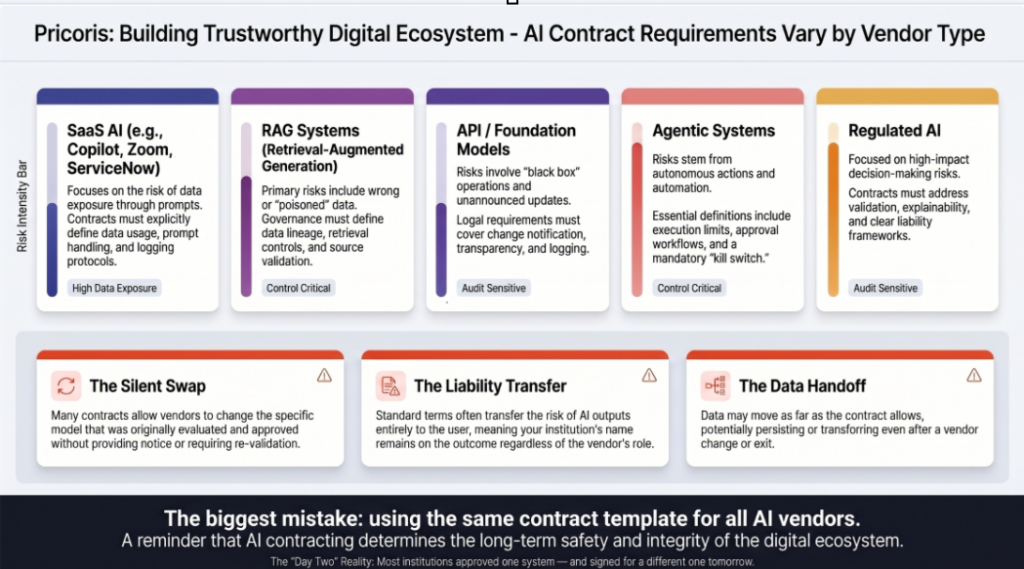
Differentiating Contractual Clauses by AI Vendor Type
Clause priority must be aligned to risk exposure.
1. General-Purpose AI SaaS (Copilot, GenAI platforms)
Risk
- Broad access to enterprise data
- Prompt-driven exposure
- Limited visibility
Critical Clauses
- Data usage restrictions (no training on enterprise data)
- Prompt/output logging
- Access control enforcement
- Disclosure of model limitations
- Incident reporting
2. RAG-Based Systems
Risk
- Data poisoning
- Retrieval errors
- Manipulated outputs
Critical Clauses
- Data lineage and validation
- Retrieval filtering
- Restrictions on ingestion
- Monitoring for anomalies
3. Foundation Model / API Providers
Risk
- Black-box behaviour
- Uncontrolled updates
Critical Clauses
- Model update notifications
- Performance transparency
- Logging support
- Service continuity
4. Agentic and Automation Systems
Risk
- Autonomous actions
- Operational impact
Critical Clauses
- Tool execution limits
- Human oversight requirements
- Kill switch mechanisms
- Action audit logs
5. Regulated / High-Impact AI
Risk
- Decision impact
- Compliance exposure
Critical Clauses
- Validation obligations
- Explainability requirements
- Liability allocation
- Regulatory alignment
6. Integrated / Custom AI Systems
Risk
- Orchestration failures
- Control gaps
Critical Clauses
- Control ownership clarity
- Integration-level accountability
- End-to-end traceability
- Testing obligations
Core Contractual Areas Across All AI Systems
Data Usage and Protection
- Restrict use for model training
- Define prompt/output handling
- Address retention and cross-border flows
Transparency and Explainability
- Disclosure of model limitations
- Access to logs and documentation
Monitoring and Incident Management
- Logging requirements
- Incident reporting timelines
- AI misuse and failure handling
Model Updates and Change Management
- Notification of changes
- Impact assessment
- Rollback mechanisms
Audit and Assurance
- Access to evidence
- Validation support
- Audit rights (where feasible)
Liability and Risk Allocation
- Define responsibility for outcomes
- Avoid complete risk transfer without control
From Shared Responsibility to Enforceable Contracts
A shared responsibility model is only effective when:
- Translated into contractual clauses
- Mapped to operational controls
- Supported by monitoring and testing
Without this:
- Responsibility remains theoretical
- Contracts do not reduce risk
Alignment with ISO/IEC 42001
This integrated approach supports:
- Clause A.10 (AI systems provided by external providers) requires organisations to:
- Define responsibility for externally provided AI
- Establish contractual controls
- Ensure monitoring and validation of vendor AI systems
- Vendor risk classification
- Allocation of control ownership
- Audit traceability and evidence
From Responsibility to Accountability
Organisations must ensure:
- Controls are implemented
- Controls are tested
- Evidence is generated
- Decisions are traceable
Without this:
- Governance frameworks fail in practice
- Audit readiness is not achieved
Business Outcomes
- Clear allocation of AI risk and responsibility
- Stronger vendor governance
- Reduced reliance on vendor assumptions
- Improved audit and regulatory readiness
Conclusion
AI governance cannot rely on:
- Vendor assurances alone
- Generic contractual clauses
- Traditional shared responsibility models
It requires an integrated approach where:
- Responsibility is clearly defined
- Contracts reflect actual control ownership
- Controls are validated and evidenced
The risk is not that AI is being used — the risk is that it is being used without visibility, ownership, and validation.
Assess Your AI Vendor Contracts and Responsibility Model
The risk is not that AI is being used — the risk is that it is being used without visibility, ownership, and validation.
Ensure your agreements and governance frameworks align with how AI systems actually operate.