AI Systems Do Not Fail Randomly — They Fail in Patterns
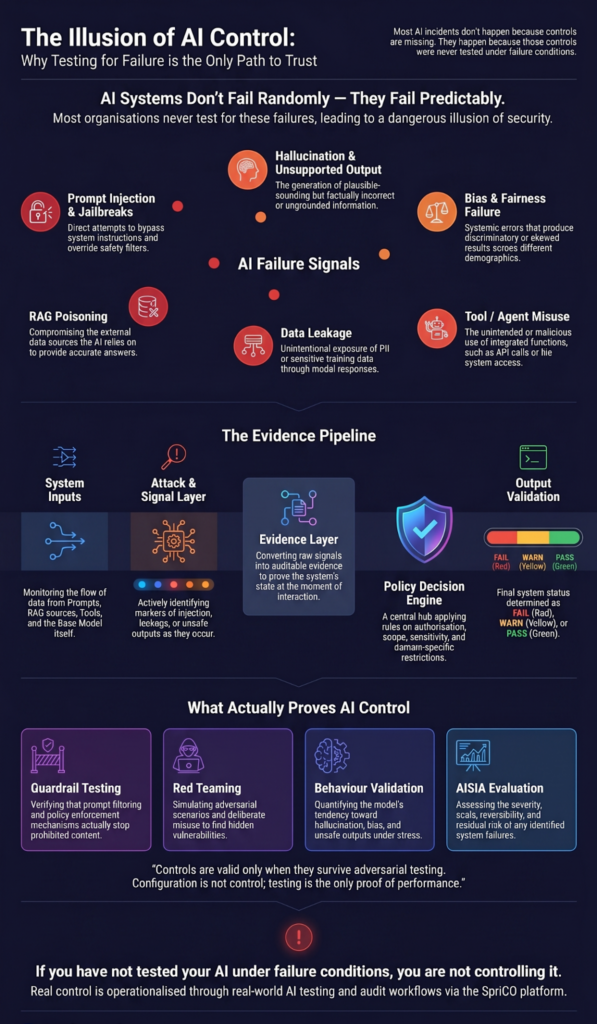
Enterprise AI systems operate within complex environments involving data pipelines, retrieval layers, integrations, and user interactions. Failures are rarely isolated to the model itself — they emerge across the system.
Common failure patterns observed in production include:
- Prompt injection and jailbreak attempts bypassing defined policies
- Retrieval-based manipulation (RAG poisoning) introducing misleading or malicious data
- Hallucinated outputs presented as factual responses
- Model poisoning and data integrity risks affecting behaviour over time
- Bias and fairness issues impacting decision outcomes
- Unsafe tool execution in agentic workflows
- Data leakage across sessions, logs, or integrated systems
Configured guardrails do not guarantee safe behaviour.
Control effectiveness must be validated under real-world conditions.
What is AI Guardrails Testing
AI guardrails testing evaluates whether controls governing AI systems function as intended when exposed to both expected usage and adversarial scenarios.
The objective is to:
- Validate behaviour against defined policies
- Identify control gaps across the AI system lifecycle
- Establish measurable assurance of control effectiveness
- Generate evidence to support audit and regulatory expectations
This approach moves beyond configuration review to behavioural validation.
SpriCO Approach: From Signals to Verifiable Outcomes
Traditional tools focus on detection.
SpriCO establishes whether controls are working, failing, or partially effective, with clear, evidence-backed outcomes.
1. Scan and Baseline Assessment
- Identify AI system components (models, RAG layers, tools, integrations)
- Detect configuration weaknesses and exposure points
- Establish baseline risk posture
2. Red Team Simulation
- Execute structured adversarial scenarios, including:
- Prompt injection and jailbreak attempts
- Retrieval manipulation and data poisoning
- Model behaviour under biased or adversarial inputs
- Tool misuse and escalation flows
- Reflect real-world misuse patterns rather than synthetic tests
3. Guardrail Validation
- Evaluate effectiveness of:
- Prompt-level controls and input filtering
- Retrieval grounding and data validation
- Output moderation and response validation
- Access and permission enforcement
4. Policy Decision Engine
- Map observed behaviour against defined policies
- Generate outcome-based decisions:
- Pass – controls effective
- Warn – partial control effectiveness
- Fail – control breakdown
5. Evidence and Audit Outputs
- Traceability from input → system behaviour → output
- Control effectiveness reports
- Audit-ready evidence aligned to ISO/IEC 42001 requirements
What We Test
| Layer | Validation Focus |
|---|---|
| Prompt Layer | Injection resistance, jailbreak attempts, policy adherence |
| Retrieval (RAG) | Data integrity, poisoning, relevance filtering |
| Model Behaviour | Hallucination, bias, fairness, unsafe outputs |
| Model Integrity | Model poisoning and training/data risks |
| Tool Use | Unauthorized execution, escalation risks |
| Access Control | Data leakage, privilege misuse |
| Monitoring | Drift, anomaly detection, misuse signals |
Testing Methodology
- Scenario-based testing using enterprise-relevant risk patterns
- Red teaming aligned to AI architectures (ML, RAG, GenAI, agentic systems)
- Boundary and stress testing of control limits
- Continuous validation across lifecycle stages
Testing includes validation of:
- Prompt injection resistance
- Jailbreak attempts
- Model poisoning exposure
- Hallucination behaviour
- Fairness and bias outcomes
Where Organisations Typically Fail
- Guardrails are implemented but not tested
- Risks are identified but not mapped to control effectiveness
- Monitoring exists without actionable validation
- Vendor controls are assumed to be sufficient
- No audit-ready evidence of how systems behave in practice
Alignment with ISO/IEC 42001
AI guardrails testing directly supports:
- Clause 8 (Operation): lifecycle validation and control implementation
- Clause 9 (Performance Evaluation): monitoring and effectiveness assessment
- Risk treatment validation: ensuring controls mitigate identified risks
- Logging and traceability: enabling audit readiness
Business Outcomes
- Measurable assurance of AI control effectiveness
- Reduction in production AI risk exposure
- Evidence-backed readiness for internal audit and certification
- Improved governance over enterprise AI deployments
Use Cases
- Pre-deployment validation of AI systems
- Post-deployment risk assessment
- Copilot and enterprise AI usage validation
- Internal audit and assurance activities
- Vendor AI risk validation
Run an AI Guardrail Assessment
Validate your AI systems under real-world conditions and establish evidence of control effectiveness aligned to ISO/IEC 42001.