
DPDP compliance in India requires organisations to operationalise consent management, data retention, data subject rights, breach response and governance controls.
Next batch: 21–22 October 2026
Get DPDP certified in 2 days
Accredited DPDP Act 2023 & Rules 2025 course for DPOs and privacy teams. ₹16,500 + GST.
View course & dates WhatsApp usSearch interest around “DPDP compliance and certification” continues to grow. However, DPDP does not provide a formal certification. Organisations must instead demonstrate compliance readiness, auditability and enforceable controls.
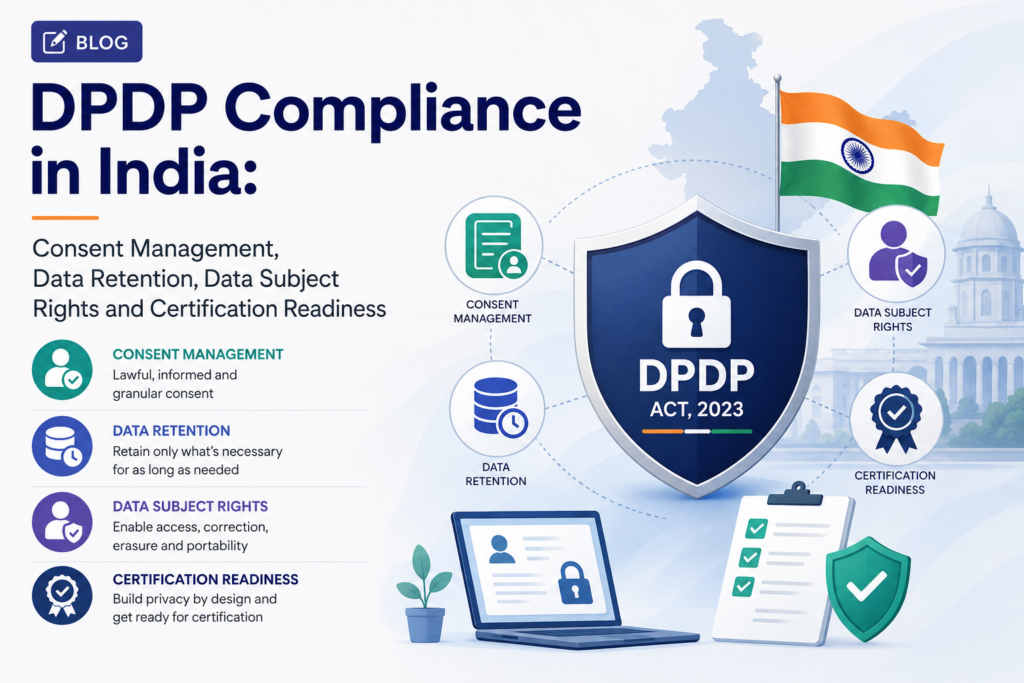
This framework outlines a structured DPDP compliance implementation approach, with specific focus on consent management and data retention, which are the most critical enforcement areas.
Step 1 — DPDP Applicability and Compliance Gap Assessment
Assess applicability as a Data Fiduciary and identify gaps across:
• Consent management practices
• Data retention controls
• Vendor and processor exposure
• Incident response readiness
Establishes baseline for DPDP compliance implementation.
Step 2 — Personal Data Discovery, Inventory and Data Flow Mapping
DPDP compliance depends on visibility of personal data.
Outputs:
• Personal data inventory (mapped to purpose)
• Data flow diagrams across systems and vendors
• Classification aligned to sensitivity and use
Enables consent enforcement, retention control and rights fulfilment
Step 3 — Consent Management and Legitimate Use under DPDP
Consent management is a core DPDP compliance requirement.
Consent management controls:
• Consent must be specific, informed and unambiguous
• Withdrawal must be as easy as consent
• Consent records must be maintained and auditable
Legitimate use:
• Must be clearly defined and documented
• Applied consistently across processing activities
Weak consent management is one of the highest-risk DPDP non-compliance areas
Step 4 — Data Retention and Deletion under DPDP
Data retention is a regulatory control under DPDP, not an operational choice.
Data retention controls:
• Purpose-based retention schedules
• Alignment with Indian legal requirements (tax, corporate, sectoral laws)
• Automated deletion / anonymisation mechanisms
• Evidence of deletion
Poor data retention practices increase regulatory risk and breach exposure
Step 5 — Risk Assessment and Significant Data Fiduciary Evaluation
Assess:
• Volume and sensitivity of personal data
• Scale of processing
• Potential harm to individuals
This supports evaluation as a Significant Data Fiduciary (SDF).
Implications:
• DPO requirement
• Enhanced audits
• Stronger governance
Drives DPDP compliance maturity and certification readiness positioning
Step 6 — Vendor and Processor Controls and Data Protection Agreements
DPDP compliance risk increases with third-party processing.
Critical principle:
Liability remains with the Data Fiduciary, not the processor
Controls required:
• Data Protection Agreements (DPA)
• Contractual clauses for security, breach reporting and audit rights
• Monitoring of vendor compliance
• Cross-border data transfer safeguards
Essential for DPDP compliance defensibility and audit readiness
Step 7 — Data Subject Rights Management
DPDP mandates operationalisation of individual rights.
Rights:
• Access
• Correction
• Erasure
• Grievance redressal
Implementation:
• Request handling workflows
• Identity verification
• System-wide data retrieval capability
• Response tracking
Directly linked to consent management and data inventory accuracy
Step 8 — Data Breach Notification and Incident Response
DPDP requires notification of personal data breaches.
Controls:
• Breach identification and classification
• Response playbooks
• Notification workflows
• Vendor incident integration
Critical for regulatory compliance and reputational protection
Step 9 — Governance, Oversight and DPDP Compliance Readiness
DPDP compliance requires sustained governance.
Governance elements:
• Defined ownership across Privacy, IT, Legal and Business
• Board-level visibility
• Integration with enterprise risk management
Monitoring metrics:
• Consent metrics
• Data retention compliance
• Breaches and incidents
• Data subject requests
Enables continuous DPDP compliance and audit readiness
Is DPDP Certification Available in India?
There is currently no formal DPDP certification issued by the Government of India.
However, organisations pursue:
• DPDP compliance assessments
• Privacy frameworks (e.g., ISO/IEC 27701)
• Internal audits and readiness programmes
“DPDP certification” typically refers to demonstrable compliance and audit readiness
FAQ
DPDP Compliance, Consent Management and Retention FAQs
1. What is consent management under DPDP?
Consent management refers to obtaining, recording, managing and enabling withdrawal of user consent for personal data processing.
2. What are data retention requirements under DPDP?
Personal data must be retained only as long as necessary for the defined purpose and deleted thereafter unless required by law.
3. Is DPDP certification mandatory?
No. There is no statutory certification. Organisations must demonstrate compliance through controls and audits.
4. Why is consent management critical for DPDP compliance?
Consent is the primary legal basis for processing. Invalid or untracked consent can lead to regulatory violations.
Next batch: 21–22 October 2026
Get DPDP certified in 2 days
Accredited DPDP Act 2023 & Rules 2025 course for DPOs and privacy teams. ₹16,500 + GST.
View course & dates WhatsApp us