
Data breach management is a critical requirement under DPDP compliance in India. Organisations must detect, assess and notify personal data breaches in a structured and timely manner
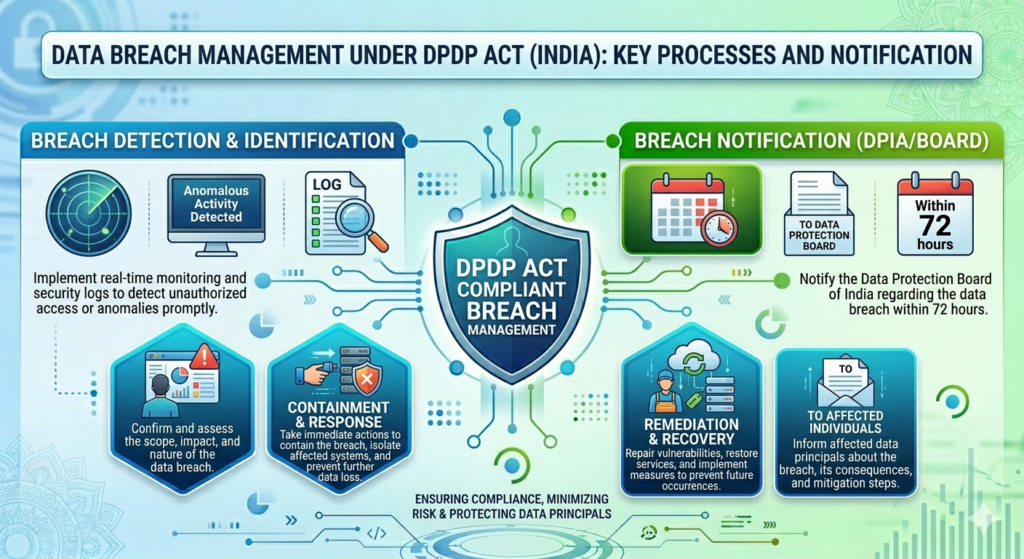
A breach is not only a security issue but a regulatory and governance obligation
What is a Personal Data Breach
A personal data breach includes
• Unauthorised access
• Disclosure of personal data
• Alteration of data
• Loss or destruction
Sources of breach
• Cyber attacks
• Insider actions
• System failures
• Vendor incidents
DPDP Breach Notification Requirement
Organisations must
• Notify the Data Protection Board
• Inform affected individuals
Key expectation
• Timely and accurate notification
Breach Management Lifecycle
| Stage | Key Actions | Evidence |
| Detection | Identify incident | Alerts and logs |
| Classification | Determine if breach involves personal data | Assessment report |
| Containment | Limit impact | Response actions |
| Investigation | Identify root cause | Forensic report |
| Notification | Inform regulator and individuals | Notification records |
| Recovery | Restore operations | Recovery logs |
| Review | Improve controls | Lessons learned |
Breach Classification
Key questions
• Was personal data involved
• Was there unauthorised access or disclosure
• What is the potential harm
Incorrect classification leads to compliance gaps
Incident Response Framework
Roles
• IT Security for detection and containment
• Privacy and Legal for assessment and notification
• Business teams for impact management
• Communications for external messaging
Controls
• Incident response playbooks
• Escalation matrix
• Communication templates
• Decision authority
Vendor and Third Party Breach Risk
Risks
• Delayed reporting by vendors
• Limited visibility into vendor systems
• Cross-border complexity
Controls
• Contractual notification clauses
• Defined reporting timelines
• Audit rights
Linkage with Retention and Consent
Retention
• More retained data increases breach impact
Refer Data Retention under DPDP
Consent
• Unauthorised processing increases exposure
Refer Consent Management under DPDA
Logging and Monitoring
Minimum requirements
• System activity logs
• Monitoring dashboards
• Alerting mechanisms
• Forensic readiness
Lack of logs makes breach assessment non-defensible
Common Failures
• No clear breach definition
• Delayed detection
• No escalation clarity
• No predefined notification workflow
• Vendor incidents not tracked
These gaps weaken compliance readiness
Executive View
Data breach management impacts
• Regulatory exposure
• Reputation
• Financial loss
• Operational continuity
Effective breach response is essential for DPDP compliance
FAQs
What is a data breach under DPDP?
Unauthorised access, disclosure, alteration or loss of personal data
Is notification mandatory?
Yes organisations must notify regulator and affected individuals
Do vendor breaches count?
Yes Data Fiduciary remains accountable
How should breaches be managed?
Through structured lifecycle and response framework
Also Read